
Uncategorized
10mm vs. 9mm for Home Defense
Jul
10mm vs. 9mm for Home Defense: Which Caliber Actually Wins?
If you’ve spent any time in gun shops or online forums, you’ve run into the 10mm-vs-9mm debate. It’s one of the oldest arguments in the handgun world, and it resurfaces every time someone starts building a home
defense plan from scratch. Both cartridges work. Both have loyal followings. But they solve slightly different problems, and picking the wrong one for your situation can mean the difference between a pistol
you shoot confidently under stress and one you flinch away from. This guide breaks down the real ballistic numbers, recoil differences, and practical home-defense tradeoffs between 10mm Auto and 9mm Luger no marketing hype, just the data and how to apply it to your specific situation.
A Quick History: Why Two Calibers Exist for the Same Job
The 9mm Luger (9x19mm Parabellum) was developed by Austrian designer Georg Luger in 1901 and has spent over a century becoming the most widely issued handgun cartridge on earth. Its combination of manageable recoil, high magazine capacity, and low cost made it the default choice for militaries and police departments worldwide, including the FBI. 10mm Auto is much younger. Legendary firearms trainer Jeff Cooper helped develop it in the early 1980s as a cartridge that could match the stopping power of a .45 ACP while retaining a flatter trajectory and higher velocity. The FBI actually adopted 10mm briefly in the late ’80s before backing off to a reduced-power “FBI Lite” load and eventually 9mm largely because full-power 10mm proved too punishing for the average agent to shoot accurately and quickly under stress. That history matters, because it’s still the core tradeoff today: 10mm hits harder, 9mm is easier to run fast.
Ballistics Head-to-Head
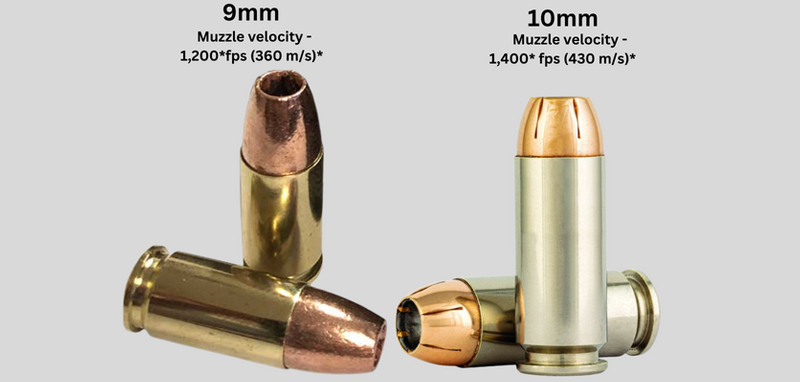
Numbers vary by load, but general performance ranges look like this:
| Metric | 9mm Luger | 10mm Auto |
|---|---|---|
| Typical bullet weight | 115–147 gr | 155–200 gr |
| Muzzle velocity | ~1,000–1,300 fps | ~1,100–1,400+ fps |
| Muzzle energy | ~350–450 ft-lbs | ~650–800 ft-lbs |
| Felt recoil | Low-moderate | Moderate-high (platform dependent) |
The takeaway from independent gel testing is consistent across sources: both cartridges, loaded with quality defensive ammunition, meet the FBI’s 12–18 inch penetration standard. 9mm gets there efficiently with less recoil. 10mm gets there with a wider margin of energy and penetration, which matters more when barriers interior doors, drywall, car glass are part of the equation.
Recoil and Controllability: The Real Deciding Factor
On paper, 10mm looks like the obvious winner for raw power. In practice, recoil management is what determines whether a home-defense round actually works when it matters. A cartridge you can’t put back on target quickly under stress is a liability, not an advantage. This is where platform choice matters as much as caliber choice. A subcompact 10mm carry pistol can be genuinely unpleasant to shoot fast. But a larger-format, mechanically buffered 10mm pistol changes the equation entirely. The B&T APC10 Pro, for example, uses an internal hydraulic buffer system specifically to soak up 10mm’s recoil impulse, which independent range reviewers have noted makes the platform noticeably more controllable than its raw ballistic numbers would suggest — even in rapid strings of fire.
Video: Independent range review of the B&T APC10 Pro, demonstrating recoil behavior and handling.
Capacity and Ammo Cost
9mm still wins decisively on both fronts. Standard 9mm handguns carry anywhere from 15 to 19+ rounds and cost roughly $0.30–$0.35 per round for practice ammo. 10mm typically runs in 15-round magazines at best
(matching Glock 20/29 pattern mags) and costs noticeably more per round due to lower production volume and heavier bullet weights. If your home-defense priority is high round count and low-cost, frequent practice, 9mm remains the more practical everyday choice. If your priority is maximum energy transfer per shot and you’re willing to train more deliberately, 10mm has a real case.
When 10mm Makes the Most Sense for Home Defense
- Rural or semi-rural homes where barrier penetration through exterior doors or thin
walls is a bigger concern than in an apartment. - Households already invested in the 10mm/Glock 20 magazine ecosystem, where adding a
second 10mm platform means zero new magazine purchases. - Shooters who want one gun that doubles as a woods/property-carry piece for
predator defense, since 10mm has genuine credibility there in a way 9mm does not. - Compact PDW-style pistols that use mechanical recoil mitigation (hydraulic buffers,
heavier bolt mass) to make full-power 10mm shootable in rapid strings this is precisely the niche
platforms like the B&T APC10 Pro were built for.
When 9mm Is Still the Smarter Default
- First-time gun owners who need to shoot comfortably and often to build real proficiency.
- Anyone prioritizing magazine capacity over per-shot energy.
- Households where multiple family members of varying size/strength may need to operate the gun.
- Budget-conscious buyers who plan to train frequently.
The Bottom Line
Neither cartridge is objectively “better” they’re built for different tradeoffs. 9mm optimizes for speed, capacity, and controllability. 10mm optimizes for energy and penetration, and modern platforms with recoil-mitigating engineering have made it far more practical for home defense than it was in the ’80s and ’90s. If you’re drawn to 10mm’s ballistic advantages but worried about recoil, a compact PDW-style pistol with a hydraulic buffer system like the B&T APC10 Pro is worth handling before you rule the caliber out.
Frequently Asked Questions
Is 10mm too much recoil for home defense?
It’s more than 9mm, but platform design matters enormously. A heavier pistol or a hydraulic-buffered system tames felt recoil significantly, making follow-up shots manageable for most trained shooters.
Does 9mm penetrate enough for self-defense?
Yes. Modern 9mm hollow-point loads consistently meet the FBI’s 12–18 inch gel penetration standard, which is why 9mm remains the standard-issue round for the FBI and the majority of U.S. police departments.
Why would someone choose 10mm over 9mm at home?
10mm offers a meaningful edge in energy transfer and barrier penetration through doors, walls, and light cover an advantage some homeowners weigh higher than 9mm’s lower recoil and higher capacity.
Sources & Further Reading
- The Armory Life — 10mm vs. 9mm: Revisiting the Handgun Cartridge Debate
- Target Barn — 10mm vs. 9mm Caliber Comparison & Gel Testing
- RECOIL Magazine — Review: B&T APC10
- YouTube — Range Report: B&T APC10 Pro (10mm Pistol)
- YouTube — 9mm vs 10mm: Is There Really That Much Difference?
Ready to see the platform built for full-power 10mm?
Check out the B&T APC10 Pro 10mm 7″ 15rd Pistol
— Glock-lower compatible, 15-round capacity, hydraulic buffer system.
